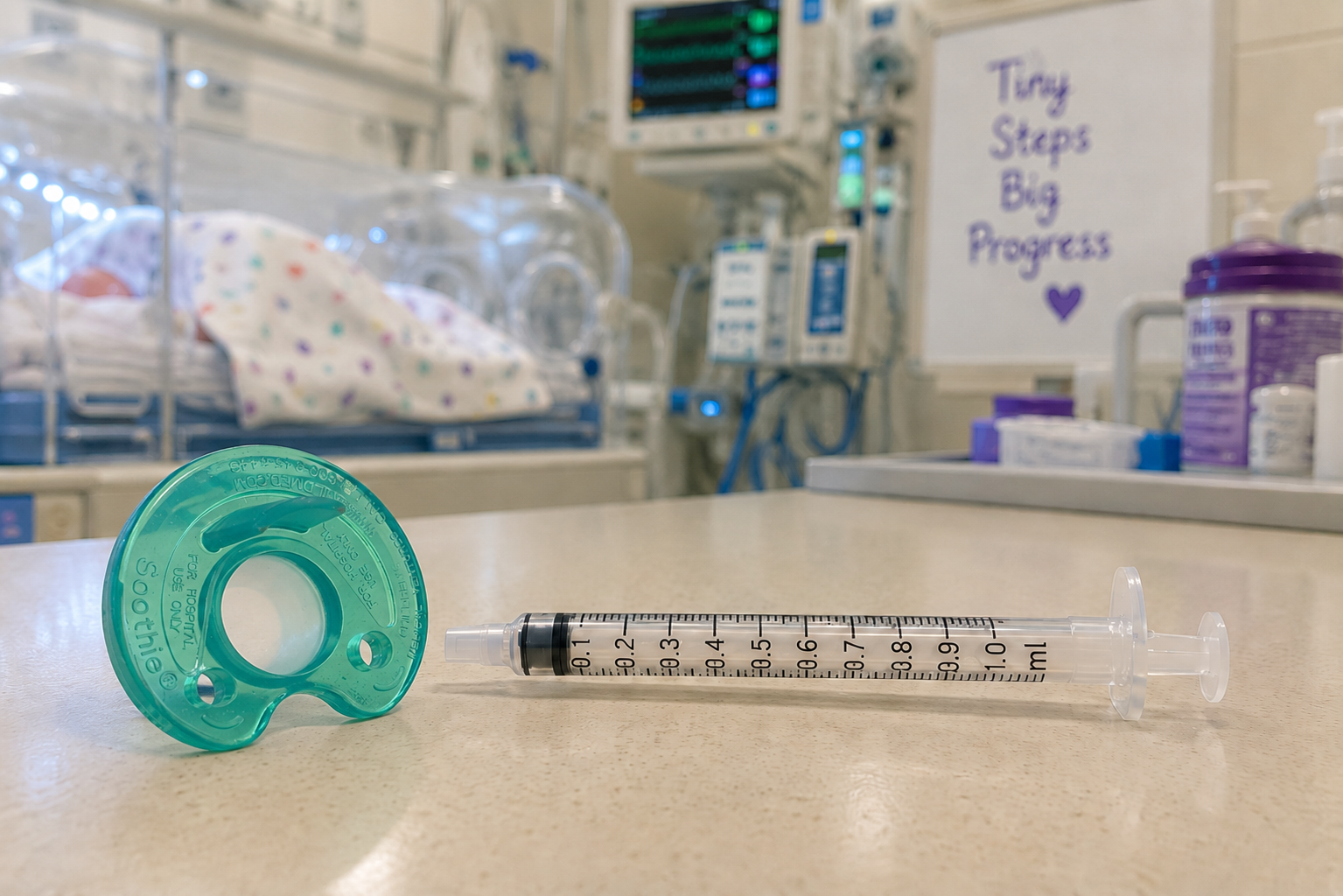
The Theoretical Basis for Simulated Feedings
One of the questions I am asked most often is, "Why simulated feedings?" “What is the evidence to support this work?’”
It's a fair question. But perhaps the better question is:
What is the clinical rationale for not preparing an infant before asking them to feed?
As neonatal therapists, preparation is the foundation of nearly everything we do.
We don’t wait until a baby can achieve flexion to offer positioning support. We don’t wait until they have complex motor skills before helping them move. We don’t wait until they can tolerate louder sound before carefully introducing voices. We don’t wait until discharge to begin parent education. We prepare. We scaffold. We gradually build the skills infants will need before the demands become overwhelming.
So why would feeding be any different?
Feeding is arguably one of the most complex developmental tasks we ask premature infants to accomplish. It requires the seamless integration of behavioral organization, respiration, swallowing, oral motor control, sensory processing, endurance, autonomic regulation, and learning—all while the infant is still underdeveloped and potentially recovering from critical illness.
Yet our traditional model often asks infants to move directly from non-nutritive sucking to unmitigated bottle or breast feeding with very few opportunities to experience the pieces of feeding first.
It is a bit like handing someone a finished novel and expecting them to read fluently before they've ever practiced the alphabet.
Simulated feedings offer something different.
They create opportunities to experience feeding in smaller, more manageable doses. Instead of asking an infant to coordinate continuous milk flow, they may first learn to organize around a single swallow. Before managing repeated swallows, they can practice adapting to two. Before sustaining a feeding, they can experience brief moments of success that challenge—but do not overwhelm—their current abilities.
This isn't about "doing feeding earlier."
It's about grading complexity.
It is the same principle that underlies nearly every rehabilitation profession.
We don't begin physical therapy by asking someone recovering from a stroke to run.
We don't teach handwriting by expecting children to compose essays on the first day.
We don't ask a novice pianist to perform a concerto before learning scales.
Instead, we identify the component skills, create experiences that are achievable, and gradually increase the challenge as competence develops.
Why should feeding be exempt from these same principles?
Perhaps because feeding has traditionally been viewed as something that simply "turns on" once infants reach readiness.
But decades of research across developmental neuroscience, motor learning, and dynamic systems theory tell us something different.
Complex skills emerge through experience. Experience our infants would have been getting in utero.
The nervous system learns by adapting to challenges that are just beyond current abilities—not challenges that are so great they result in potential failure, nor limiting our preparations with experiences so simple that no adaptation is required. Learning is achieved through repeated opportunities to solve increasingly difficult problems.
This is precisely where simulated feedings fit. They are intended to bridge the enormous gap between no feeding experience and oral feeding demands.
They provide opportunities for our infants to experience swallowing before swallowing hundreds of times.
To coordinate sucking and swallowing before adding the complexity of continuous milk flow.
To adapt to changing sensory and motor demands while the stakes remain low.
To experience success. And perhaps that is the most important point.
Every day in the NICU we modify environments, reduce complexity, support regulation, and scaffold development so infants can be successful when new challenges arise.
Why would we abandon those principles when it comes to feeding?
We benefit tremendously from clinical trials, but progress within our field also depends on sound clinical reasoning — using the evidence we have while allowing our practice to be guided by clinical expertise, observation, and a deep understanding of the human experience.
The equally important question is this:
If we believe in graded learning, developmental preparation, motor adaptation, and infant-centered care in every other aspect of neonatal therapy... what is the theoretical justification for not preparing infants before introducing one of the most demanding developmental tasks they will face?
Perhaps this is where we begin shifting the conversation as a profession.
